Followers

Showing posts with label Sauce / Salsa. Show all posts

8/26/11

Molcajete


The molcajete and tejolote (mulcazitl and texoloti, in Nahualt) are what is known as the mortar and pestle tool used for grinding various food products. The use of the molcajete dates back several thousand years and was used by pre-Hispanic cultures including the Aztec and Maya. Traditionally carved out of a single block of volcanic rock, molcajetes are typically round in shape and supported by three short legs. Nowadays, molcajetes can also be found in different shapes carved with various animal heads. Sometimes you can find one in the shape of a bowl, using a pedestal base for support instead of legs. Tejolote is the matching hand-held grinding tool and it's also made of the same volcanic rock.


Molcajetes are used to grind chiles, nuts and spices, and to prepare salsas and guacamole. But a molcajete can also be used as a cooking tool by heating it in a very hot oven or over hot coals and then use it to heat food. It can also be use as a serving dish for hot food or chilled for salads and cold seafood dishes. 


This ancestral tool makes the best flavored salsa. There is something about this rock that gives salsa a unique flavor. Molcajetes, some people say, much like cast iron skillets, carry over flavors from one preparation to another. 

There are many recipes for chile de molcajete but my favorite is the one prepared by my brother-in-law, Juan. His recipe is featured in One Big Table, the book written by Molly O'Neill and it is also in Chile Frito, a small recipe book written by me. Now I'm sharing it here.


El Chile de Juan
(Recipe by Juan Siordia)

2 habanero chiles
3 lb. jalapeños
4 lb. güerito chiles (yellow Fresno chile)
2 lb. serrano chiles
1/2 lb. dried red peppers 
10 lb. vine ripe tomatoes (Roma tomatoes work well for this salsa)
5 lb. tomatillo, with husks
1 head of garlic
1 can Mexican beer (Tecate or Corona go well with this)
salt to taste

On a cast iron griddle over the stove or an outdoor grill, roast all the vegetables a day ahead. Store in the refrigerator overnight. The next day, mash the peppers in a molcajete one at the time starting with the habanero and ending with the dried red peppers. Remove husk from tomatillos. Add the tomatoes and tomatillos to molcajete in between chiles. When the mixture starts thickening, add beer to the molcajete as needed.  

If you have a small molcajete do this in batches. Transfer the salsa to a bowl. Mash the garlic and add to the bowl. Add salt to taste and more beer if needed. The salsa should have the consistency of a thick and chunky purée. Drink the left over beer.

Serves approximately 50 people!


5/25/09

The Red Sauce

I use several kinds of chile sauces when I'm cooking Mexican food - green, yellow, white, creamy, but probably the most used in my kitchen is the red sauce.

I made a red enchilada sauce a few weeks ago with New Mexico red dried peppers that Rich, my husband, bought from a street vendor in Tucson. One day, we were going to have a potluck at work and somebody volunteered me to bring the salsa, but I forgot to make it. On the day of the potluck, I got up early in the morning and remembered that I was supposed to bring the salsa. I looked into my refrigerator and saw a jar halfway full with enchilada sauce but no hot salsa. I grabbed the enchilada sauce, a couple of jalapeño peppers, one tomato and some leftover cilantro. I blended it all together, placed it in a jar and took off for work with my improvised salsa, hoping that people would like it even a little. To my surprise, everyone loved it, including myself!

Here is the recipe for my original enchilada sauce and a tip on how to turn extra enchilada sauce into a great hot salsa (when one forgets to make one from scratch).


Red
Enchilada Sauce with Sunflower Seeds

10 New Mexico dried red peppers
1 T pepper seeds
2 T sunflower seeds
1 T dried oregano
3 garlic cloves
1/2 medium onion
salt to taste

Clean and divein the peppers scraping the seeds. Save 1 Table spoon of seeds and discard the rest. Toast pepper seeds and sunflower seeds in a dry cast iron pan until they become aromatic. Remove from the pan. Next toast the oregano until it becomes aromatic, it will only take seconds. Grind all three ingredients in a molcajete (mortar and pestle). Briefly toast the peppers being careful not to burn them. Place the peppers in a bowl and cover with boiling water. Soak for 15 minutes until they rehydrate and become very soft. In the same pan, roast the onion (peeled) and garlic (with paper on) until they become tender. Peel the garlic, drain the peppers saving about 1/2 cup of the soaking water and transfer all ingredients into a blender or food processor; purée until smooth. Pass the sauce through a semi fine strainer, discard the solids left on the strainer and store the sauce in a jar in the refrigerator until ready to use.

This sauce is not spicy as New Mexico peppers are not too hot but if you like it milder, you can roast one tomato and add it to the blender before puréeing.

I use this sauce for enchiladas but when I have a little extra, I boil one tomato with one or two jalapeño peppers. Place them in a blender with the extra sauce and a handful of cilantro, purée and turn it into a hot salsa.


3/13/09

Chile de Molcajete


In my family, there are two words for hot sauce. Salsa is the word for the sauce we use to give other food an extra flavor during the cooking process. Normally this is not too spicy. Chile is the one we use as a condiment after the food has been cooked. We like this very hot and we add it to almost everything on our plate. We've learned that here in United States, most people refer to chile as salsa so now, we too call it salsa.

We like all kinds of salsa but we have our favorite - chile de molcajete! This salsa is made by mashing the ingredients in a molcajete (mortar) with a tejolote (pestle) made out of lava rock. There is something about this rock that gives salsa a unique flavor. It doesn't matter who makes it or what kind of peppers are used, it is always good. In the last few years, we leave it to my brother-in-law, Juan to make this salsa. We call it "el chile de Juan" and every one laughs because it has a double meaning that every Mexican can understand. I'm a little embarrassed to say it... but it means Juan's penis (Mexicans always add a double meaning to words, it is part of the culture.)
I make chile de molcajete mostly for special occasions but, I bought some beautiful tomatoes at Little Italy Mercato and decided to make some. Here is one recipe:


Chile
de Molcajete with Toasted Pepitas

10 small dry red peppers
1/4 c. pepitas (pumpkin seeds)
2 garlic cloves
2-3 large tomatoes
Salt
2 T. cilantro - finely chopped (optional)

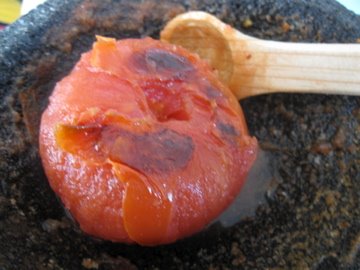
In a dry cast iron griddle (I always use my aluminum griddle) toast the seeds and the peppers being careful not to burn them. Remove from the griddle and set aside. With out peeling the garlic, roast it in the same griddle. Remove from the griddle when the paper starts to burn; set aside. Next, roast the tomatoes until they become soft and the skin blackens and blisters. While the tomatoes are roasting, place the pepitas and peppers in the molcajete and mash them down with the tejolote until they form a dry paste. Remove paper from garlic, add to the molcajete and continue mashing. Add the tomatoes and continue mashing down. Add salt to taste. The salsa should have a consistency of a thick and chunky purée. I did not use cilantro this time but if using, stir in the cilantro at this point. Enjoy with corn chips or add to your favorite tacos.